Sunday, December 03, 2006

Drinking and the Bible

www.reverendfun.com

I enjoy talking about what the Bible has to say about drinking. Really, if you investigate it closely, there's a lot more than most people would think.

Compare these two verse selections:

This is what the LORD, the God of Israel, said to me: "Take from my hand this cup filled with the wine of my wrath and make all the nations to whom I send you drink it. When they drink it, they will stagger and go mad because of the sword I will send among them."

So I took the cup from the LORD's hand and made all the nations to whom he sent me drink it
...

"Then tell them, 'This is what the LORD Almighty, the God of Israel, says: Drink, get drunk and vomit, and fall to rise no more because of the sword I will send among you.' But if they refuse to take the cup from your hand and drink, tell them, 'This is what the LORD Almighty says: You must drink it! See, I am beginning to bring disaster on the city that bears my Name, and will you indeed go unpunished? You will not go unpunished, for I am calling down a sword upon all who live on the earth, declares the LORD Almighty.'

Jeremiah 25:15-17, 27-29

The woman was dressed in purple and scarlet, and was glittering with gold, precious stones and pearls. She held a golden cup in her hand, filled with abominable things and the filth of her adulteries.

Revelation 17:4


The common image in the above verses is the cup. In these passages, the cup symbolizes the authority and power of i's bearer.

When Joseph tricked his brothers by hiding his cup in the youngest sibling's bag in Genesis 44, the crime is especially grievous because the supposed theft involved an item that was valued, not for its price so much as it's owner. This is especially obvious in Jeremiah, when God states that even if the nations refused to drink His cup, they will indeed drink, meaning God not only had the right to punish the nations, but also the ability to do so.

Of course, we can't overlook the most important aspect of the cup - that it carried something to the drinker. In the Old Testament, God's wrath is often depicted as a cup filled with wine. The wine is described as mixed or filled with spices - characteristics which imply an enhanced ability to inebriate. Moreover, note what God says about the effect of his wine in Jeremiah 25:16:

When they drink it, they will stagger and go mad because of the sword I will send among them."

Note the effect of God's wrath is twofold: those who drink His cup will stagger and go mad.

Each effect is important. To stagger is to physically stumble. To go mad is to lose mental competence. Thus, those who experience God's wrath will suffer both physically and mentally - in much the same way someone who drinks too much alcohol does.

But don't think that the effect of drinking God's wrath leaves the drinker feeling like a frat boy fully-lit on Absolut. Your typical frat-party patron reels and mumbles because he's so drunk he has no control of his body, but it can be rather pleasant (vomiting and hangover aside). But imagine reeling from intense pain and being so mentally distraught you can't speak a clear sentence. Really, what kind of pain and suffering would it take to reduce someone to a babbling vegetable?

Let's jump ahead into the New Testament. Keep the imagery of the cup and wine in your mind as you read the following verses:

"You don't know what you are asking," Jesus said to them. "Can you drink the cup I am going to drink?"
"We can," they answered.

Matthew 20:22

"Abba, Father," he said, "everything is possible for you. Take this cup from me. Yet not what I will, but what you will."

Mark 14;36

Jesus commanded Peter, "Put your sword away! Shall I not drink the cup the Father has given me?"

John 18:11

Understanding the Old Testament imagery and meaning of the cup casts light on Christ's use of the metaphor in the New Testament. Jesus made these references as the time of his death approached, and if we examine Christ's suffering on the cross, we see that He suffered both physical and mental (or spiritual) anguish.

If you look at Christ's last words on the cross, John Stott points out that two of them deal with His physical pain. Namely, "I thirst." The remainder of His words dealt with His spiritual suffering. For example, "My God, my God, why have You forsaken Me?", and "Father, forgive them, for they know not what they do". These words are the results of Jesus drinking the cup of God's wrath. The physical portion was the most cruel, barbaric, and horrible way a human being could (and still can) possibly die. Yet Christ minimized the focus on His physical pain because the mental / spiritual pain was far greater - the experience of being abandoned by God.

But the cup imagery doesn't stop there:

While they were eating, Jesus took bread, gave thanks and broke it, and gave it to his disciples, saying, "Take and eat; this is my body."

Then he took the cup, gave thanks and offered it to them, saying, "Drink from it, all of you. This is my blood of the covenant, which is poured out for many for the forgiveness of sins.

Matthew 26:26-28

The cup Christ offered to His disciples (and by extension, to us) was a cup of forgiveness. Remember the cup symbolizes authority and power. Christ had the authority to forigve sins (Mark 2:5) and, by His crucifixion, the power to do so.

Now look at Psalm 23:5:

You prepare a table before me
in the presence of my enemies.
You anoint my head with oil;
my cup overflows.

The cup of the children of God is a cup of blessing. Thus, Christians have the right and ability to bless.

In summary:

1. God gave Christ His cup of wrath.
2. Because Christ willingly drank God's cup, He offered us His cup of forgiveness.
3. If we willingly drink Christ's cup, we can offer a cup of blessing to others.

- Graffy

Wednesday, November 29, 2006

This Old House


New siding and insulation: $5,000
New roof: $10,000
New windows: $12,000
New HVAC: $15,000

Satisfaction in knowing I'm the new poster child for This Old House: Priceless

I am now the owner of a 3,000 square foot money pit. It has no driveway, a dilapidated garage, a bad roof, 50-year-old faux-brick celotex siding, rotting soffits, termite damage, sagging floors, no air conditioning, smelly carpets, a bathroom with a disgusting shower and a chimney that's caving in, (which, incidentally, is still the only way the furnace flue gases leave the house).

So why'd I buy it?

$31,000 on an auction is all I can say.

Maybe I should apply for an Extreme Makeover...

Sunday, November 19, 2006

You Are Who You Are

I couldn't help but notice the following argument in a post on The Beginner's Mind which asserts:

Those folks who risked their lives for the good of others practice their religion in such a way as to reflect that compassion for others. Being religious didn't cause them to help end slavery or further the civil rights movement. I'm not religious and I find common cause with the enemies of slavery and champions of civil rights. Religious beliefs reflect the believer not the other way around, in my opinion. Just as an atheist like myself gladly works for civil rights, a Christian wearing the hood of the KKK would likely have little problem with black slavery.
...
That's what we'd like removed from the public sphere; this notion that true morality and social justice flows from religion and nowhere else. And, yes, this is what conservative Christians believe.


The author presents two ideas in this statement: First, that we are who we are and our beliefs and life choices simply express this - they don't change us into something we were not before. Second, if you are a conservative Christian, you believe those who are not Christian are inherently immoral - incapable of knowing right from wrong.

The first point the author makes is not only wrong, in my opinion, but also irresponsible. He states an idea that has been popular for quite a while now - Eddie Vedder sang about it in a rather bland song of his entitled "Who You Are" on Pearl Jam's "No Code" album. The refrain was "You are who you are". a nice little New Age mantra, perhaps, but not worth an awful lot when you're dealing with social issues of the day. Nevermind the fact that the remainder of the lyrics were, in Eddie Vedder's trademark fashion, mumbled incoherently. Not that it would havea mattered, for it seems the remainder of the lyrics were chosen largely because their rhyme and meter, not for any particular meaning. It's interesting to note that when one of alternative rock's premier bands writes a song about the meaning of humanity, it amounts to a song about nothing...

All of this, of course, is also contrary to what Christianity teaches in 2 Corinthians 5:17:

"Therefore, if anyone is in Christ, he is a new creation; the old has gone, the new has come!"

What the author argues is fatalistic and, in my opinion, unsustainable in the face of documentable human behavior. For example, Jane Roe of Roe v. Wade publicly repudiated the abortion right for which she so ardently strove in that landmark 1973 case, but she only did so after becoming a Christian. Theodore Weld became a Christian under the preaching of Charles Finney (a man whom he hated) and began the American abolition movement in the early-mid 1800's. In both cases, we see people ultimately behaving contrariwise to who they once were. This raises the question, did they really change? If so, then "You are who you are" loses it's definitive, fatalistic edge and becomes a meaningless mantra not quite worthy of Yogi Berra.

The "You are who you are" philosophy does not admit change. It's a popular lie that is told especially loudly in homosexual circles to keep gays who do not wish to be gay from seeking treatment. The philosophy hinders true social change, and while I'm certain the author wouldn't express it in these extreme terms, if we apply that philosophy everyone, then who can fault John Mark Karr for being addicted to kiddie porn? After all, that's just the way he is, right?

Grotesque humanistic New Age philosophy aside, one issue remains: that conservative Christians believe that morality can only be found in Chistianity. As a conservative Christian, I reject that outright - and always have. Most any Christian who knows their faith well enough knows that is false. We need only cite Romans 1 or, better yet, Romans 5:14,15 to point out that everyone knows the difference between right and wrong. After all, why would a non-Christian demand justice for wrongs committed if they had no sense of morality to begin with? While I know some in Christianity may express it in those terms, most would not. From the conservative Christian viewpoint, an atheist civil rights activist who has righted numerous social wrongs in their lifetime has no more claim on heaven than any professing Christian wearing a KKK hood.

Christianity clearly teaches it is not about what you've done or what you know. It's about Who you know and what He's done.

- Graffy

Saturday, November 11, 2006

Supernatural Christianity

www.reverendfun.com

I've recently been listening to a set of tapes loaned to me by a friend from church. He gave them to me after I gave my "spiritual gifts" lesson in an adult Sunday School class a few weeks ago. Anyway, the album is entitled "The Fourth Wave" by David Pawson.

In this lecture, Pawson approaches the schism in Christianity that has long separated the evangelical and the charismatic Christians. I disagreed with many of Mr. Pawson's assertions, but he raised some interesting points about what brought on the schism and how we may go about reconciling it.

He points out that in these two different perspectives on Christianity, the focus of faith gets shifted according to each group's bias. He gives a tongue-in-cheek example by pointing out that "to the Reformer, the Trinity is Father, Son, and Holy Scripture. To the Catholic, it's Father, Son and Holy Virgin Mary."

His point was that as Christians, we often ignore the work of the Holy Spirit in the church and substitute Him for an unhealthy infatuation with relics and mysticism, or exegetical dogmatism.

Pawson really got me thinking on this topic. Truly, if God is still present in this world and actively working in our lives, why do we (as evangelicals) tend to limit that action to the ways we apply Scripture to our lives? I'm not saying that most evangelicals believe God doesn't work in any other way, just that we tend to believe it happens largely by reading the Bible.

I think it's a natural tendency to minimize the spiritual aspect of Christianity in it's more "intellectual" cultures. That is, the more we focus on the exegesis and exposition of Scripture, the more we tend to think of the supernatural aspects of Christianity as being past events, not a present reality. That's something which charismatics have rejected outright, and rightly so.

Paul pointed out that our battle is not with the flesh and blood, but "against the rulers, against the authorities, against the powers of this dark world and against the spiritual forces of evil in the heavenly realms." (Ephesians 6:12)

Paul was explicit that we are at war and the war far exceeds the reality that any of us percieve. While I don't believe every misdeed is a result of demonic attack, I do believe that when we choose to follow God, Satan raises the stakes. We battle not only against our flesh, but inevitably against demonic forces. I don't pretend to know what the spiritual war Paul indicates looks like, though I can clearly point to episodes in my own life when I am certain my struggle was with more than just my own flesh.

When I compound my own experience with that of others, the evidence is too great to ignore. I've listened to friends describe their (sometimes physical) encounters with demonic forces. One pastor in our denomination described performing an exorcism which immediately healed a woman. I cannot (and dare not) discount the supernatural aspect of my faith.

I have long held that the major difference between a charismatic and an evangelical is the charismatic tends to embrace the supernatural with alarming disregard, whereas the evangelical tends to regard the supernatural in terms of disbelief, suspicion, and even fear. Whether we see our faith in charismatic or an evangelical terms, we can neither fully understand or comfortably ignore it's supernatural aspects.

By definition, the supernatural supersedes reality as we know it. Christianity teaches that it defines reality, whether we acknowledge it or not.

- Graffy


"Now we see but a poor reflection as in a mirror; then we shall see face to face. Now I know in part; then I shall know fully, even as I am fully known." (1 Corinthians 13:12)

Tuesday, November 07, 2006

Weekly Funny

A Baptist pastor was giving his sermon one Sunday morning, his vigorous preaching captivating the audience, leaving them hanging upon his every word. Yet the preacher couldn't help but notice one young man sitting in a vacant pew, just ahead of the balcony, looking as if he were drunk. He slouched in his seat, arms thrown to the sides, with what appeared to be a sneer scrawled on his face.

The young man hadn't gone unnoticed by the other church leaders in the congregation. During the sermon, several had slipped back into the pew to talk to the young man, to encourage him to sit up and pay better attention, but to no avail.

Finally, the preacher could take it no longer. Stopping in the middle of his sermon, he stepped from his pulpit, strode down the aisle, and stood before this irreverent-looking young man.

"Son," said the preacher, "Why don't you sit up and pay attention to the sermon?"

The young man simply rolled his eyes at the preacher and grunted.

Annoyed by the audacious behavior of this unknown congregant, the preacher demanded, "Boy, where are you from?"

The young man gazed at the preacher and said in a very pained voice, "... the balcony..."

Sunday, November 05, 2006

Christianity and Politics in America

[This is a little off topic for me, but my curiosity got the better of me...]

I have often heard it said
that 85% of America is Christian, an assertion I've always considered it to be bogus.

To be sure, what defines a "Christian" directly influences that percentage. For example, many Muslims consider themselves (by Islamic doctrine) to also be Christian, so who's to say they're wrong? Thus, when someone describes so much of the American population as being Christian it would do well for the reader to very carefully consider the writer's bias.

George Barna, a Christian pollster, compiled some interesting statistics regarding Christianity in America:

  • 9% of US adults classify as evangelicals (2006)
  • 36% of US adults classify as born again, but not evangelical. (2006)
  • Atheists and agnostics comprise 10% of adults nationwide. (2006)
  • 10% of the US population identify with a faith other than Christianity (2006)
In his classifications, Barna was smart enough to realize it's not what you say that makes you what you are, but what you believe. Thus, when he classified people as "born-again" or "evangelical", he used strict criteria to define them.

To quote the website,
In Barna Research Group studies, born again Christians are not defined on the basis of characterizing themselves as "born again" but based upon their answers to two questions. The first is "have you ever made a personal commitment to Jesus Christ that is still important in your life today?" If the respondent says "yes," then they are asked a follow-up question about life after death. One of the seven perspectives a respondent may choose is "when I die, I will go to Heaven because I have confessed my sins and have accepted Jesus Christ as my savior." Individuals who answer "yes" to the first question and select this statement as their belief about their own salvation are then categorized as "born again."

Since only 36% of Americans would classify themselves as "born-again", the statement that "85% of Americans are Christian" is clearly false. Truly, if one is to call himself or herself Christian, acceptance of Jesus' death on the cross as a substitute for our sin (made possible by his resurrection) is the qualifying belief that defines one as a Christian. To deny this doctrine is to deny what makes Christianity what it is. Also, Barna's definition of "Evangelical" is a sub-classification of a "Born-Again", that is, an Evangelical meets seven further criteria in addition to the two laid out for a Born-Again.

So where's the rest of the supposed 85%?

Barna classifies more of the U.S. population as being "Notional Christians". Such people may claim to be Christian, but do not believe that they will go to Heaven on the basis of Christ's death and resurrection (because they simply don't believe it happened). 39% of the U.S. population can be classified as Notional Christians, bringing the total "Christian" population to about 75%.

Often, the "85% Christian" statistic is quoted for politial purposes. Politically speaking, however, a profession of faith hardly equates to an alliegance to any one political party. The political breakdowns of the Notional and Born-Again Christians (including Evangelical) shows that 40% of non-Evangelical Born-Agains align themselves with the Democratic Party along with 42% of the Notional Christians.

Thus, for political purposes, if we take 75% (not 85%) of the culture to be "Christian", fully 30% of the American "Christian" population is Democrat. Another 27% may be considered Republican, leaving 43% in the lurch.

Looking at the numbers, it would seem that while religious views have created polarizations in American politics, it hardly divides Americans on public policy like some would claim. Rather, from the religious sphere, we see that the split between Republican and Democrat is nearly equal and the majority of "religious" (again, not necessarily "Christian") people claim no aliegance, though they may have conservative or liberal leanings.

- Graffy

Tuesday, October 31, 2006

Family Update


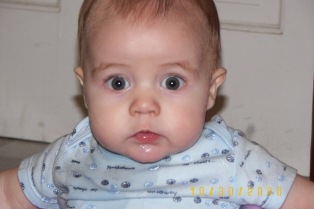
Hey.

Whaddya lookin' at?

Micah is now almost 5 months old. At his 4-month checkup, he weighed in at 15 lbs, 8.5 ozs. and 27 inches. He wears 9-12 month-old clothes regularly and he just recently graduated to the next size in diapers. Not sure that's a cause for celebration, though I could see how some people might think so...

In any case, he gets more interesting by the day. He enjoys exporing his vocal chords and grabbing anything that gets within arm's reach. He's taken a keen interest to solid food that mom and dad eat, though the jury's out on when he'll get his first taste.

Beyond that, he's a squeaky, drooly baby boy for whom the cat carries no great affection...

Monday, October 30, 2006

Weekly Funny

In November of 2004, Dr. Ravi Zacharias was invited to speak at the Mormon Tabernacle in Salt Lake City, Utah. He accepted - on the condition that he could choose the topic. They agreed. The speech he gave is, in my opinion, one of the greatest speeches ever given on the supremacy of Christ. In addition, this honor was very unique because the last non-Mormon person to speak at the Mormon Tabernacle was D.L. Moody at the end ofthe 19th century.

What follows is the joke Ravi told to open his speech...

An Englishman had been invited as an honored guest at a society function and as he arrived, he took his appointed position at the head table near the speaker's lectern. After seating himself, he noticed across the table a rather anxious-looking Japanese gentleman. Guessing the Japanese man was suffering cultural anxiety, the Englishman thought it might be a good opportunity to instruct him in the basics of English ettiquette.

He picked up a fork, and, looking at the Japanese gentleman, he pointed to it and said, "This be forkey." He then laid down the fork, picked up the spoon and said, "This be spooney." Continuing in this fashion he introduced each of the table serviceware, referring to them as "knifey, platey," and the like. All the while, the Japanese gentleman observed the Englishman and nodded courtesously after each lesson.

Finally, the time had arrived for the keynote address. Much to the astonishment of the Englishman, the Japanese man rose and took the lectern as the keynote speaker. He then went on to deliver his talk in flawless English.

After completing his speech and returning to his seat, the Japanese man looked straight at the Englishman and asked,

"You likey speechey?"

Wednesday, October 25, 2006

It's All Greek To Me

www.reverendfun.com


Ah, yes. How I miss the heady days of Optimus Prime and the Autobots raging against the evil forces of Megatron and his Decipticons. I miss those guys...

Anyway, I just thought I'd share some of the interesting tidbits that come out of my occasional forays into New Testament Greek.

First, courtesy of my friend Ron, did you know that never in the New Testament does the word "atonement" appear? We often refer to Christ's death on the cross as an "atoning sacrifice". But to atone is an Old Testament word that essentially means to cover over or make up for your sin. The authors of the New Testament never held that view. In the New Testament, Christ's death is a propitiation - it's a complete removal of the sins we bear - not merely a "covering over".

Second, did you know that when Jesus was transfigured on the Mount in Matthew 17, He was really transforned?

In New Testament Greek, there are four words that are used to describe changes people undergo. There are "morphoo" changes and "schema" changes. "Morphoo" changes are changes in form (think metamorphosis) whereas "schema" changes are changes in appearance only (think schematic - a figure or representation, but not the thing itself). Thus the New Testament describes changes in these four terms: Configure, Transfigure, Conform, and Transform.

So how does this apply to New Testament thinking?

In all cases except one, "schema" changes are used in a negative context. Satan "transfigures" himself into an angel of light in 2nd Corinthians and we are not to "configure" ourselves to the present age in Romans 12.

Opposite that are the "morph" changes - changes in actual form, not the appearance of it. These are always positive. In Matthew 17, Jesus was literally "transformed" (not transfigured). Paul exhorts us to be "conformed" to the image of Christ (Romans 8).

It is one thing to be changed in how you look. It is something wholly different to be changed in who you are.

When Satan transfigures himself into an angel of light, he can only "meta-schema" or trans-figure how he looks. However, his change does not reflect who he truly is. No matter how much Satan may disguise himself as an angel of light, it forever remains that - a disguise. He is still a minister darkness. He has been transfigured, but not transformed.

When Christ was changed on the mountain, we say in English that He was transfigured. But really, He was transformed. He literally became something in human form that He was not before. Paul exhorts us to "be transformed" by the renewing of our minds with that same word in Romans 12.

So what makes a transformation more than just a transfiguration? A "transformation" in the positive sense is a complete change, but it is a change that is based upon an underlying reality. Christ was transformed in body to reflect His divine nature and Paul exhorts us to be transformed by the renewing of our minds to reflect the
nature God has already given us.

To simplify the idea then, to "transfigure" or "configure" is to change how we appear to reflect something apart from ourselves. To "transform" or to "conform" is to change how we appear to reflect what God already says is true about us.

So, there you have it.

Be Ye Transformed.


Monday, October 23, 2006

Weekly Funny

After waving down a taxi, a rather rushed businessman hopped into the back seat and hurriedly gave the driver his destination. The cab driver, a nervous-looking middle-aged man, nodded tentatively at his passenger's orders and and pulled back into traffic. As the trip passed, the businessman grew impatient with his drivers slow driving habits. So, he reached out and grabbed the cab driver's shoulder in an effort to urge him to pick up the pace a little.

No sooner had the passenger's hand touched the driver's shoulder did the driver let out a terrified, blood-curdling scream, slam his foot to the accelerator, and began carreening wildly through traffic. The hair-raising experience came to an abrupt halt as the cab slammed into a building facade on the opposite side of the street.

As the two sat there, somewhat stunned over what had just occurred, the driver looked back at the passenger and said, "Please! Don't EVER do that again!"

The passenger, his impatience long forgotten in the rush of mad fear for his life, looked at his driver apologetically. "Sorry," he stammered.

The driver's expression softened. "It's alright, " he replied. "It's not your fault. This is my first day on the job."

"You see," the driver went on to explain, "I used to drive a hearse..."